Wednesday, November 19, 2008

26. The Phantom Of The Opera - 1925

Director: Some nobody which is why I'll probably stop doing this section from now on unless I think it's especially relevant. Look it up yourself if my review doesn't mention it.

Synopsis: A phantom of the Parisian opera house forces the opera house to use Christine as their star because he loves her. The phantom lures Christine to his lair and professes his love. She removes his mask revealing his ugly countenance. She says she will be his slave forever but goes back on her promise. The phantom kidnaps her and Christine's boyfriend follows. Everyone in Paris also follows because they all find out where the phantom's lair is the exact same day. They are not particularly kind to the phantom. Also, there is some color footage.

Review: The version I watched was the 1929 version I believe.

In the early days of cinema, multiple versions of movies were made for a few reasons. Movies would be made for theaters (un)able to play sound films, later censorship or for foreign release (I find the two versions of The Testament Of Dr. Mabuse to be the most interesting as sound was so expensive that filming a movie twice was cheaper than redubbing a film for foreign markets!).
The most common version--read: the only one I have had the chance to see--of The Phantom Of The Opera is the 1929 version. The film was re-edited, used some different takes, used less color footage and incorporated sound differently. So, I'm not sure where the problems with this film began.

It's not that this movie does anything wrong; it never does anything as well as it should have. The Phantom Of The Opera is a perfect example of a movie that is almost great. There are some interesting elements here that are never fully explored. The movie could have been a straight horror movie or about a tormented musical genius gone mad or about love/obsession or a mystery. It tries to be all four and doesn't do any of them all that well.

Had the movie focused on one or two elements, it could have been a much better movie. It could done everything with a much longer running time--we call that the Dr. Mabuse, der spieler ratio--but it didn't. As it stands, most of the elements feel truncated. Since the movie supposedly follows the source novel closely, it's possible that this problem originated here.

That's not to say there isn't some great stuff here. This was popular enough to essentially spawn Universal's classic horror movies of the 1930s. That alone makes this meritorious. It is a perfect template for those movies in that the plot basically follows this formula:

Monster loves woman. Woman is horrified by monster and engaged to another. Woman's fiancée is not having it. Townspeople are also not having it. Monster is killed by torch and pitchfork wielding mob.
The memorable differentiation between these monster movies is the monster itself. Like the rest of the monster movies since The Phantom Of The Opera, the monster is one of the only things worth the viewers' time. The rest of the movie is waiting for the monster.

The monster is something to behold and not only because he is the only character written to have more than one dimension. Lon Chaney's make up is amazing. Apparently, smelling salts were kept on hand in case people fainted during the reveal of his skull-like face as shown above (compare the 1929 and 1925 unmasking shots here; the original is better). It is more impressive than the skull mask he wears to the masked ball later seen below. While the skull mask is creepy, it doesn't allow for any emotional acting like Chaney's make up does.

As you may have noticed from above still, this is the first color film--in part--on the list. It is not the first color film in whole or in part as films with color existed through various processes since probably the late 1890s. For example, A Trip To The Moon from 1902 supposedly exists in a hand colored version. The Phantom Of The Opera used Technicolor Process 2 (read how it works better than I can explain it here).

A final note and only because it is the best scene in the movie and I love it:

The Phantom, surrounded by the local townspeople, reaches into his cloak. He removes his hand clutching something that causes the mob to recoil. He opens his hand to reveal...nothing. The mob descends on him (an alternative ending featured Christine giving the Phantom her ring before leaving with her fiancée causing the Phantom to die of a broken heart).

Final score: 6/10

Friday, October 31, 2008

25. Seven Chances - 1925

There is a really tall woman just above Buster's head to the right.Director: Buster Keaton

Synopsis: To inherit seven million dollars, Buster Keaton must be married by 7:00pm on his 27th birthday which just so happens to be--gulp--TODAY!

Review: I must confess that I have actually seen The Bachelor starring Chris O'Donnell. I don't have a reason. It wasn't at the behest of a girlfriend. It wasn't the Ludovico technique. I sat down for no apparent reason and watched The Bachelor...probably on TBS.

"...because it was there" — Sir Edmund Hillary

Anyway, I was completely unaware until about a day before watching Seven Chances that The Bachelor was a remake of this movie (Seven Chances is itself an adaptation of a play). I don't remember how closely The Bachelor followed Seven Chances as the only memorable portion was Chris O'Donnell being chased by a mob of women in bridal gowns.

It is unfortunate that the only really memorable thing about Seven Chances is also the chase. The first half of this movie as Buster Keaton struggles to find a bride is acceptable but it's nothing particularly special after seeing some other Keaton work. It never took off as much as it probably could have. It seemed maybe too easy I suppose.

One bit that worked well was a reveal, after Buster makes his approach, that a woman has a child. After confirming the child is hers, Buster inquires whether or not she plans to take care of it. It was the biggest laugh for me until the chase scene.

The chase scene is the main reason to watch this. Buster Keaton gets to a church where his friend has assured him that a bride will be waiting and hundreds of women are ready to marry into seven million dollars. Not being keen on this idea, Buster runs through a series of increasingly dangerous and ridiculous gimmicks as Buster Keaton is known to do.

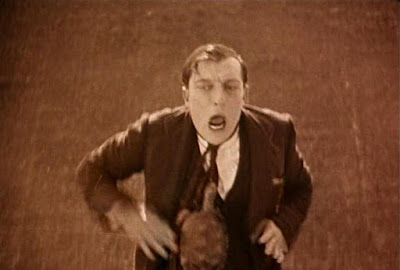
My personal favorite is this turtle holding onto his necktie:
Like much of the chase, there's very little reason or context for this. I like to imagine the writing process for movies like this because I wonder how something like this comes about. "Buster should jump in a river for three seconds just so he can come out with a turtle hanging from him."
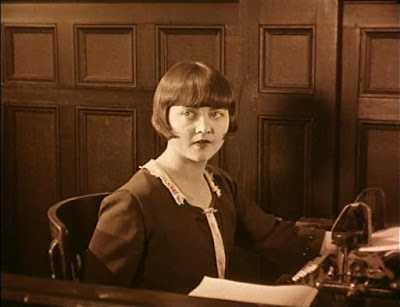
So, old movies are pretty racist. (nice transition)

Buster becomes pretty desparate for a wife at a certain point in the film and asks almost every woman he comes across including drag queen Julian Eltinge. Buster doesn't bother asking a Jewish woman or a black woman as soon as he discovers their ethnicity. I guess that was probably funny in 1925. The only prominent black character is in black face as well.

Also of note is Christina Ricci's cameo:
Watch out Speed!  The mammoth car is right behind you!I liked this movie overall but it never felt like it was as funny as a Buster Keaton film should be (Keaton didn't even want the only surviving copy restored. I enjoyed Neighbors included on the DVD more than Seven Chances.

7/10

Friday, October 24, 2008

24. Der Letzte Mann (The Last Laugh) - 1924

Director: F. W. Murnau

Synopsis: A hotel porter is demoted to washroom attendant because he is old. His job, and uniform, brought him respect in his poor neighborhood. He hides his demotion from his family and friends by stealing his uniform. Upon being discovered, he loses all prestige and becomes miserable. Then the ending. The horrible horrible ending.

Review: It has been my dream to be involved in writing or directing a romantic comedy. A recently divorced woman bumps into a man just this side of nebbish to still appear desirable. They do not hit it off. The divorcée's friend recommends the "perfect guy" who turns out to be the man she met previously. Through a series of crazy coincidences, the two keep running into each other and slowly bond over some ridiculous shared trait (loves dogs, ham radio, whatever). Everything goes beat for beat like every romantic comedy in history until the final five minutes. The man, after their first night together, leaves the house. Shortly thereafter, the director to a local asylum for the criminally insane knocks on her door to inform her that her new lover is an escaped murderer. The boyfriend comes in, sees this and murders the both of them in a scene just gorenographic enough for Murder-Set-Pieces or the eventual movie of Blood Meridian. Credits roll.

What does this have to do with Der Letzte Mann?

Der Letzte Mann's ending is as surprisingly antithetic as my torture porn/romantic comedy and completely ruins everything the previous 95% of the movie. I knew going into this that the ending was supposedly tacked on by the studio and undermines what Murnau was doing. I imagined something pretty ridiculous and Der Letzte Mann went beyond my imagination. Never will there be an ending so bad, so tacked on, as this and I have seen A. I. If you remember The Simpsons episode with the alternative ending to Casablanca where Ilse parachutes from the plane killing Hitler and marries Rick with Sam playing piano outside the church, this is the kind of tacked on happy ending Der Letzte Mann has (see The Simpsons take on Casablanca here starting at 12:47). It overshadows the preceding 80 minutes and ruins the entire experience. I am genuinely angry at having sat through that ending.

I know movies are ultimately a product. Studios want to protect their investment and make money. It's a film industry. That doesn't mean films can't be altered for the good by a studio. I suspect the 155 minute version of Tati's Play Time drags even more than the current version. Maybe the excised footage from The Wizard Of Oz slowed down the film. I don't know but I know which version of Brazil or Army Of Darkness I prefer. I know that no one is asking to see the theatrical release of Touch Of Evil or the 141 minute version of Seven Samurai. Der Letzte Mann is the best example of why studios shouldn't meddle in movies. Of all the footage lost forever, why couldn't the last few minutes of this join it?

The ending is so horrifically bad, this screen precedes it:
Enough about the ending because it really shouldn't be here at all.

When Norma Desmond said in Sunset Blvd. that silent movies didn't need words because they had faces, this is the kind of movie she was talking about. This movie has only one intertitle before the introduction to the, ugh, end. The entire movie really is told by the faces of the characters. The doorman is in virtually every scene and without words he makes every scene watchable (partly because of his great facial hair).

With no dialogue or intertitles to tell the story, the movie relies even more than the average silent film on overacting. After losing his job, the porter is so overcome with shame and emotion that he moves about like a character from a Rankin/Bass Christmas special. It's unnerving to see the almost stilted movement.

More unnerving is the porter's phyical transformation. This still shows the porter at his absolute best in the film: This still is him at his worst:He has gone from smiling which a woman on each arm to a jobless thief who apparently has chosen the path with the least amount of grooming. Even his previously immaculate uniform has started to fall apart.

That is, essentially, the movie. It's watching a man lose everything for no real reason. It is not a uniform and job to him. It is his dignity--his means of respect from his peers--being taken from him. All because he is aging he loses everything.

So, it's not quite a feel good movie. It's a feel bad movie but the kind that is completely watchable and engrossing. If you want to feel bad, this is the movie to watch. If you want to feel even worse in a totally different way, watch the ending.

A final note because it must be mention. This has probably the most influential camera work in film history and the modern audience probably won't notice. F. W. Murnau called in "unchained camera technique." The modern terminology is "movement." There is no existing film released before Der Letzte Mann with a moving camera. It is believed that Der Januskopf may have had one scene with a moving camera, but it can not be confirmed as it is lost forever.
All camera movement--as this entire list from a few movies from now should contain save maybe some Ozu (heh)--can be tied back to this movie.

Score: 9/10 Please please please stop the movie before the tacked on ending.

Friday, October 3, 2008

23. Sherlock, Jr. - 1924

All the cars, minus that one in the foreground are moving.  Seriously.Director: Roscoe "Fatty" Arbuckle, Buster Keaton

Synopsis:They don't write 'em like that anymoreBuster Keaton is wrongfully accused of stealing a watch. He falls asleep and it all comes together nicely in the end...nicely for Buster Keaton not the guy that actually stole the watch.
Review: Film has the ability to be the most oneiric medium if only because it can assault the senses easier than any other medium. Adding that film typically assaults two senses--three or more if Odorama or Percepto is involved--which is one up on most other media, it is more immersive by nature. Seeing a film feature a dream literally become a movie is interesting at least.

The best part of Sherlock, Jr. aside from the "How did Buster Keaton not die while doing that?" motorcycle section is the movie within a dream within a movie. I really couldn't decide what part struck me hardest: Keaton walking from the stage through the screen or Keaton's reacting to the ever changing background. Barring this being removed from Youtube, see it here. It's obvious that jump cuts were used extensively to place Buster in the rapidly changing background but it's staged so well that it's hard to spot.

Beyond blurring the distinction of film and dreams, reality is added into this. It's a blurring of Keaton's dream, the film Keaton is watching which is also called Sherlock, Jr., and how each of these things affects Keaton's reality within the film.

Keaton is dreaming about himself Sherlock, Jr. while the film's audience watches Sherlock, Jr. while we are watching Keaton as Sherlock, Jr. I am having flashbacks of trying to explain Wes Craven's New Nightmare to someone right now and my mind is being blown by the comparison. Anyway, Keaton is dreaming of the case being solved and he awakes to the case being solved. Even Last Action Hero didn't get this deep. My mind is again blown by this apt comparison.

Enough of all this high brow dissection of Sherlock, Jr. This movie is funny. Isn't that what Buster Keaton is all about? I know The General is general-ly considered Keaton's masterpiece but I have my doubts after seeing this; I haven't seen it recently enough for a quality comparison. I guess I will know in a couple weeks when I see The General again.

This benefits so much more from being shorter--44 minutes--than Our Hospitality. There is no room for boredom. Even if a joke doesn't work which is rare in this one, another one immediately follows it. This suffers a bit from the same "flaw" of Our Hospitality that audiences have seen physical comedy evolve for 80+ years. Portions of this don't work quite as well as they did in 1924. Buster does his physical work as well as anyone today does and does it better for the most part.

For example, the still above is from Buster Keaton riding on the handle bars of a motorcycle with no driver through moving traffic. It's amazing because there about a dozen scenes that are all ridiculously dangerous and this isn't the scene where he BROKE HIS NECK. I could go on about the amazing physical work Keaton employs here and elsewhere in the film but it must be seen to be believed.

I suppose the plot is kind of lacking on this but it doesn't really matter. Sherlock, Jr. was made to have Buster Keaton do his thing which he does. Even the subdued by comparison to his death defying work is great. He can show pain and dejectedness in his face gaining the right amount of sympathy and laughs.

Some side notes that don't really fit in anywhere else and I'm too lazy to flow into rest of this:

Something I had never seen in a film before or since is the actors--not characters--named in the intertitles. I had technically seen this before but must shamefully admit to wondering why the Canfield family in Our Hospitality had a daughter named Natalie Talmadge. Ummm...I am a stupid.

Of particular note is the horrific score on the Kino print. I think it was by Club Foot orchestra or something. I can not fathom someone thinking this is remotely appropriate. There are sections that border on jazz fusion. There is surf rock. There is an honest to God James Bond reference. I'm not sure which is worse, the Kino soundtrack or the Youtube clips that feature J. Geils Band and Air.

Large sections of this are on Youtube. I didn't see the part where Buster gives away dollar after dollar to movie patrons or him literally following a suspect closely. The other truly brilliant moments are there though. Find the whole thing as this is totally worth it.

Score: 9/10

22. Greed - 1924

Director: Eric Von Stroheim

Netflix doesn't have this. I found a copy online. I'll watch it at some point, but I hate staring at my crappy monitor for hours to watch a movie. I'll get around to this (soon?).

EDIT: Whoops. I had some serious computer issues and lost this file. The site from whence it came is no longer operational...again. I'll watch this some time

Wednesday, September 17, 2008

News of sorts

I was in Barnes & Nobles today and discovered, as I suspected, that different editions of this book have different films listed. I happened to notice this because the version I glanced at in the store had several movies from 2007 while mine stops with The Aviator and Million Dollar Baby (why for both choices?). I have seen all of the movie differences I noticed at the end; it isn't a big deal (why Atonement which kind of sucked after the first 30-45 minutes?).

Does anyone that happens upon this blog know where I can find a list of the movies added and removed for each edition? It appears that the editor just takes out an old movie and replaces it with some recent big name movie (Atonement? Really?). I'd like to add in the movies from different editions some time in the future.

Unfortunately, all editions have both Moulin Rouge! and Fahrenheit 9/11. I guess I can't use that as an excuse to skip them.

Saturday, September 13, 2008

21. Stachka (Strike) - 1924

Director: Sergei Eisenstein

Synopsis: Workers of a factory strike after being treated poorly and a worker suicide. The factory directors are none too happy about this. Neither side will give in and the results are violent.

Review: "The strength of the working class is organization. Without organization of the masses, the proleteriat is nothing. Organized, it is everything. Being organized means unity of action, the unity of practical activity." Lenin, 1907

That quote opens Strike. This quote, intercut with eyes staring angrily at the viewer (pictured above), closes Strike:

"REMEMBER, PROLETARIANS!"

So...Eisenstein wasn't taking a subtle approach with Strike but he once said, "I don't believe in kino-eye, I believe in kino-fist" assuring that a subtle approach wasn't to be expected...ever. Propaganda films, as this film undoubtedly is, rarely go work at a level below beating the audience over the head with its message.

While watching--but before researching--this movie, I was struck most by the juxtaposition that Eisenstein (over)uses. A large percentage of the shots reference the preceding or succeeding shot in a way to alter both had they been shown separately.

For example, the opening of the movie has an intertitle claiming the "all is call at the factory." The next shot is dozens of men and women coming in and out of a hallway filled with doors. Neither means that much when seen separately; the factory looks abnormally busy, but not enough to warrant much notice. When seen together, it comes across as a much busier--almost humorously so--factory because we are told the factory is calm.

This juxtaposition is called Soviet montage theory and Eisenstein considered it "the nerve of cinema." Again, Eisenstein wasn't one for subtlety and montage is overused. One could say that Strike is propaganda for the usefulness of montage theory. At the least, this is a primer for how to use it in film and it has been used as such--compare the finale of Strike and Apocalypse Now or most of Blood Of The Beasts or a section of Walkabout or...

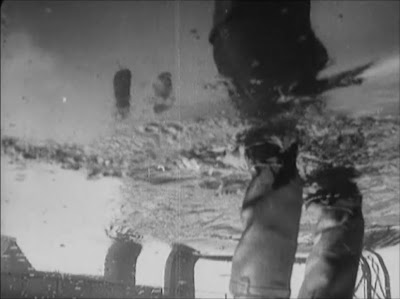
I want to comment on one particular non-montage shot that works using juxtaposition but doesn't fit in the film. It is probably my favorite shot in the movie though. This pair of legs:
walk in reverse motion to reveal this pair of smokestacks reflected in a puddle: I think the shot works only because of the similar visual composition. It make little sense within the scope of the movie. There is no reason to start with the legs upside down without context except to mirror the smoke stacks. There is no reason to have everything happen in reverse except to make this shot have smooth water in the puddle. Within this movie, it feels like complete wankery.
If this were the only film Eisenstein had done, his montage theory would be enough to make this, and him, important.

Score: 7/10