Friday, May 8, 2009

33. The Unknown - 1927

Synopsis: Alonzo is hiding in a circus as an armless performer so police will not discover his double thumb linking him to a string of circus murders. He falls for a Nanon who hates to be held. Realizing Nanon would discover his ruse on their wedding night, he has his arms surgically removed. Nanon gets over her chirophobia and falls for a strong man. Alonzo attempts to have horses rip off strong man's arms and is trampled to death in the process.

Review: You know what's unknown? Why this movie made the list! /statler&waldorf

I have nothing against b-movies. In fact, I love a well made b-movies--this is not a contradiction of terms--especially when said movie contains animals killing people but more on that when I review Jaws. I don't see why this particular movie is worthy when any other one would have fit the bill.

The Unknown has no discernable influence on film. The three big names involved--Tod Browning, Lon Chaney and Joan Crawford--are better known for other things which are worse than The Unknown--Freaks, Phantom Of The Opera and child abuse respectively. There is nothing shocking in finding out this film was lost for decades because no one remember "The Unknown" was the name of a film and not a bunch of reels to a film no one could identify.

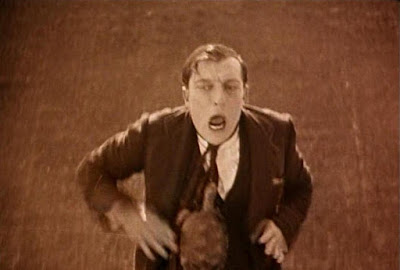
That is not to say The Unknown is a bad movie. I enjoy it. I don't see what makes this movie better than any other b-movie beyond Chaney's performance which is quite good. It might be the best performance thus for on the list. Chaney's performance, while not as natural as Nanook or as affecting as the doorman from Der Letzte Mann, is the most subtle which seems contradictory since Chaney had to act like he didn't have arms.

I attended college with a guy that had no arms. Even after seeing him do everything my arms take for granted with his feet, Chaney still impressed me. Chaney had help by having Peter Dismuki--someone actually without arms--play his feet in some scenes.

As b-movies are generally exploitive, I should be as well. Here are the top five things Alonzo does to showcase his self imposed malady:

drink some wine
wipe his brow
smoke a cigarette

play a guitar (I legitimately saw someone do this once and he did not hold the guitar at all like this)

fire a gun

So, this movie is nothing to take much notice of beyond the performance of Lon Chaney. I personally never thought one performance makes a movie great even if that performance is. The movie has a certain level of watchability but only as a novelty. If you want a superior movie with Joan Crawford revolving around circus murders, I suggest Berserk!

7/10

Monday, April 27, 2009

32. The General - 1927

Synopsis: Buster Keaton is a southern train conductor during the civil war. His girlfriend is kidnapped by nothern soldiers causing him to follow her into enemy territory. He saves her and returns home to battle the union. It is loosely based on a real life train chase.

Review: This movie feels like a compromise to me. It's bigger and grander than anything Keaton has done previously. It has a better narrative. It lost the danger and absurdity that I enjoyed most in Keaton's earlier works. I miss that off the wall, from out of nowhere humor.

I think this sets a future for bigger comedy though. It isn't just a set of gags unrelated gags based purely on Keaton's ability to endanger himself without having a facial reaction. There is even a bit that made me laugh based purely on an intertitle:
I could easily see someone like every Steve Carell character ever saying it. Unfortunately, it's one of the few genuine laughs I had in the movie. The other big one for me was a pine cone bonking Keaton on the head. The two examples give a pretty good approximation of my sense of humor: non-jokes and infantile jokes. Nothing in between the two.

The length of the movie is an issue. While the movie is still short, it would have helped to edit it some more. I've enjoyed the shorter Buster Keaton films more because they didn't leave room for anything that didn't work. The General on the other hand leaves plenty of moments waiting for the next joke to happen instead of laughing until the next joke happens.

Something that's been bothering me about these movies is the soundtracks. I can't imagine that the musical accompaniment is accurate on some of these films. There is a song that either is, or is very close to being, Sabre Dance. There is zither music which makes me think of The Third Man immediately. The music fits but is this what Buster Keaton intended? Maybe so but there has been some inconsistency throughout this list on the musical choices.

I don't have much else to say about the film. It didn't work on me like previous Buster Keaton movies. Because I can't avoid mentioning hilarious facial hair, here is the best from the film:
And, since I am a giant nerd, I want to include this picture because it makes me think of the tank levels in world 8 of Super Mario Bros. 3
Final Score: 7/10

Sunday, April 19, 2009

31. Sunrise: A Song Of Two Humans - 1927

Synopsis: A woman from the city suggests a man drown his wife. The man flies into a rage and starts to choke the woman from the city. He then changes his mind and decides to drown his wife. He starts to drown his wife but is overcome with guilt. They reconcile in the city even though he tried to murder her. They have a great day and realize why they fell in love even though he planned on murdering her. They return home and storms cause their boat to capsize drowning the wife (irony!). The woman meets the man thinking he purposefully drowned his wife but he goes tries to choke her again. The villagers find the wife alive, floating in the water. The man and wife meet as the sun rises even though he planned on murdering her.

Basically, why you always got to be murderin the women in yo life?

Review: The first best picture winner at the Oscars is usually cited as some film called Wings that no one ever talks about except when discussing Oscar history (ie - is boring everyone). If the source you happen to be reading is dedicated exclusively to Wings, the story typically stops there. If the source is not dedicated exclusively to Wings, Sunrise is usually mentioned as kind of also being best picture winner. Why this confusion?

There was no best picture nomination in 1927. Wings won "outstanding picture"--listed occasionally as "best production"--and Sunrise won a little award for "unique and outstanding production." So the Academy Awards officially list Wings as the "best picture" winner but oscars.com says "two films were singled out for top honors."

I have not personally seen Wings outside of some bootleg Paul McCartney DVDs but I know which movie has a legacy of any kind (hint: it is Sunrise). Wings isn't even available on DVD in North America but Sunrise barely qualifies as being available (only as a limited time mail in with proofs of purchase for other Fox DVDs and part of huge box sets).

Anywayz...

I watched the "Movietone" version of this film. The disc Netflix has features a "Silent European" version which, as far as I can tell, is the exact same movie but shortened by half an hour. Neither version is silent though. Quite the opposite.

This movie is the first with dialogue. It's only a a brief scene with mostly indiscriminate yelling but it is recorded dialogue. Move over Jazz Singer. Sunrise is also the first Fox movie with a recorded score. So, I'm not sure from where the "Silent European" distinction comes. Other than preparing a print for projectors unable to play films with sound, I can't see the purpose when a film features actual human voices for the first time.

Beyond it's huge step forward sonicly, this is innovative with its special effects. Some of the things stick out big time to a modern audience but they had to be amazing at the time. What amazed me most about the film visually was that this was shot on a massive set. It's not a real city and I wouldn't have known otherwise had I not read it.

Most striking of all is that this film shouldn't work but does. A man cheats on his wife, almost murders his mistress twice and his wife once over the course of a couple days. Despite that, I want the man and wife back together. Why am I worried about their relationship when I should want the wife out of there? It's a bizarre reaction. Instead of focusing on his murderin' ways, I get swept up in the love story. I guess that is the power of Murnau's directing skills and the actors; it is certainly not a testament to the story which plays like a fable.

I am not quite sure this qualifies as "the Citizen Kane of silent films" as it has been labeled it is not a misguided classification. "The greatest silent film" title is kind of crazy though. It's good but not that good.

Score: 9/10

Friday, April 3, 2009

30. Metropolis - 1927

Synopsis: Freder Frederson is a rich guy extraordinaire and son of Joh who is mayor or king or something of Metropolis. One day Maria travels to the well to do section of the city and Freder falls for her. He heads to the depths of Metropolis to Maria and sees the work conditions of the lower class (explosions).

Freder tells his father of this and goes to join the workers. He gets caught up in the revolution Maria is leading against the upper class. Freder, being upper class and sympathetic to the workers, is THE MEDIATOR BETWEEN THE HEAD AND HANDS IS THE HEART!

Joh and mad scientist Rotwang spy on Freder and discover his plan. They decide to disrupt the idea of class unification and equality by making an evil doppleganger Machine-Man of Maria undermine her plans. Maria-bot dances naked by John Mellencamp and incites the workers to violence.

Joh wants the violent revolt so that he can retaliate with violence. He allows the workers to the heart machine where they destroy it causing a flood. Real Maria and Freder save the children while Joh realizes his mistake. Rotwang comes back to kidnap Maria to probably make sweet love to her or some such. He is stopped by Freder who then becomes THE MEDIATOR!

There is also a bunch of religious stuff thrown in for no reason about the Tower of Babel.

Review: I watched the restored version that everyone has seen that runs about two hours. The uncut version found in Argentina (maybe? I don't remember) probably won't be available for a long time while restoration takes place.

Big budget, special effects laden, blockbusters enter the list. It feels insulting to compare Metropolis to the modern day blockbuster but it must be done. The similarities are too prevalent. From bad acting and huge special effects to a reliance on robots and explosions , this is as much a summer blockbuster precursor as Jaws.

The difference between Fritz Lang's Metropolis and Michael Bay's _________ is that Metropolis is worth your time. The other big difference is that people are still talking about Metropolis while most blockbusters last only until the next summer. So, enough of this Armageddon to Metropolis blasphemy.

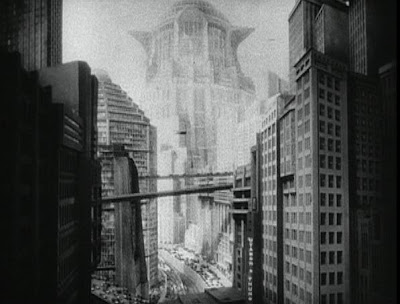
The highlight of Metropolis, as with most blockbusters (sorry) is it's visuals which more than make up for the overacting and somewhat weak story. The special effects are the main reason this is being discussed as an important film. This is the best looking film thus far on the list. The visuals are much more removed from theater than anything previous. Seeing this
is mind boggling in its complexity for the time. All of those cars are moving. Yes, it's nothing but miniatures and matte paintings for this shot. It's striking as it's the first establishing shot that isn't a camera set up on a street somewhere. It's striking enough that blockbusters (sorry) such as The Fifth Element and the Star Wars prequels clearly owe this one shot. Visually, a lot of movies owe Metropolis quite a bit and I could easily make a post with nothing but comparison pictures (I say easily but I'm not about to go through the trouble of looking for all of the relevant screen captures when I couldn't find a good enough Fifth Element shot online).

The other lasting impression, which predates Metropolis, is the plight of the worker in the future compared to the luxury of the wealthy. For example, the wealthy get to dance around in a garden straight from A Trip To The Moon with their tie tucked into their pants all freaking movie:
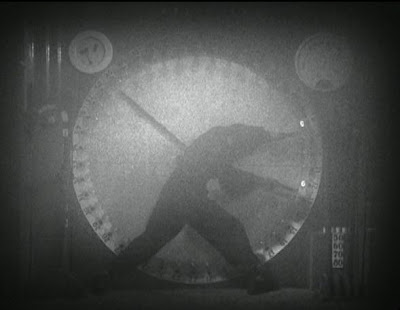
Workers spend their days pointing arrows at shifting lights in a more serious take on Modern Times until they pass out from exhaustian:
I know dystopian future, timely as ever and all that. There apparently hasn't been hope for the distant future since the dawn of man but it's especially hopeless here. A shot of the worker's conditions: followed by how it's viewed by the main character:
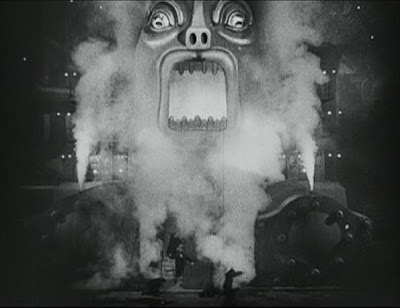
Again, the visuals make this movie better than its standard--by now anyway--everything else.

Continuing an idea put forth in Mabuse, Lang decided to put a little bit of everything into this movie for no discernable reason other than he could do it. Metropolis feels this way in a truncated form and I can't imagine how much bigger, more epic, it will feel when the general public gets to see the original cut. It's big enough now with thousands of extras and massive sets that I wonder if a shortened version may beneficial.

So, Metropolis is pretty great from a visual standpoint. There is stuff that I had to look up just to figure out how it was done. The influence is still felt today and that's what frightens me. If Metropolis is a worthy addition to this list based primarily on being a special effects, what will people think of Michael Bay and Trasnformers in 80 years?

Final note: This is getting remade and Mario Kassar is producing. That means we'll probably get Roland Emmerich, Paul Verhoeven or Renny Harlin directing. I must admit that, should I suffer through this, Verhoeven's would be the most hilarious and therefore most enjoyable.

Final Score: 10/10

Sunday, February 22, 2009

29. The Big Parade - 1925

This no available on DVD. Found me a VHS copy for almost $30. I passed. Someone find this for me.

I swear I'm gonna start doing this again soon. Within a few weeks at the most unless something huge comes up (m'dong). I have been busy workin' workin' day and night with work promotions. I guess I could technically just review the next four movies as I've seen them but it's been years.

Friday, December 19, 2008

28. The Gold Rush - 1925

Synopsis: Charlie Chaplin's Tramp is a prospector. He gets stuck in a cabin with another prospector named Big Jim (who has found gold) and they almost starve. They eventually leave the cabin for town after killing a bear.

Chaplin falls in love with Georgia while in town. Georgia never shows for their New Year's Eve party where Chaplin imagines dancing with some rolls. Big Jim shows up demanding that Chaplin take him to the cabin because Big Jim only remembers that his claim is near a cabin. They become millionaires.

At some point, Black Larsen finds Big Jim's claim but falls off a mountain.

Review: There are two versions of this film. The 1925 version is silent. The 1942 version has, among some other changes, a narrative track. Netflix, much to my disappointment, sent the 1942 version.

I unfortunately didn't know that there were two versions of this movie before sending the DVD back to Netflix. The opening credits stated being a "revival." I assumed the original was lost and that it had been reconstructed as closely as possible to the original for rerelease or something similar.

I kept thinking how unusual it was that a movie from 1925 had narration. I kept thinking how bad the narration was. I kept thinking I should turn off my speakers but it had to be here for a reason. Had I know before watching The Gold Rush that the narration was foolishly added 17 years later, I would have turned off the sound instead of suffering needlessly.

I guess I understand Chaplin's reasoning for updating his movie for the revival. I completely disagree with it though. The biggest problem I have with the narration is that it clearly doesn't need to exist. It didn't offer any insight into the characters or action. Chaplin was, for the most part, telling me exactly what I could see on screen or, even worse, reciting exactly what the characters were saying. It was a distraction that covered up a quality movie.
If you'd like an idea on how this doesn't work, take a look at the closest things we have to a silent film these days: Cast Away and WALL-E. Imagine a narrator saying, "Now Tom Hanks tooth hurts. He's going to remove it with an ice skate," or "WALL-E sees a fire extinguisher. He wants to determine its function."
It's a nuisance that really should be forgotten. As such, no more talk of it for now.
The Gold Rush is apparently Chaplin's favorite film of his own. I wouldn't put it quite that high but it is a solid movie. The gags work and that's really all I need from a silent comedy.

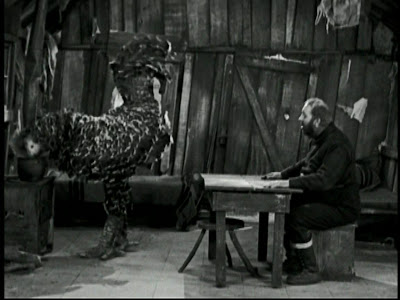
If you want to gauge how well this works, watch some Warner Brothers cartoons. Must of The Gold Rush looks like it came straight from a Warner Brothers cartoon. Strike that. Reverse it. The Gold Rush predates them and it was shocking to learn that. A lot of classic Looney Toons ideas come straight from here. How many times have you seen two starving characters each envisioning the other as a giant chicken before coming after them with murderous hunger? How many times was it done better than this:
That is priceless material right here. Had I seen that as a kid I never would have stopped laughing. It isn't all hallucinating about chickens. Every time a Warner Brother's cartoon has characters in a shack leaning precariously on a cliff, it comes back to this movie. A wimpy character thinking he knocked out a big guy when something fell on his head comes back to this movie.

Therein lies a big problem here. Chaplin was so influential--as was Buster Keaton--that I've seen the best moments here done numerous times. It's lost a lot of its value.

An interesting thing that Chaplin does here that hasn't been seen before is combining comedy and a love story. Buster Keaton films feature him going after the girl regularly but Chaplin actually goes after our emotions instead of playing it all for a laugh. You actually feel for Chaplin when Georgia doesn't show up on New Year's Eve. That might be Chaplin's best innovation for film.

Also, dancing rolls.

Score 6/10 (8/10 without the narration)

Thursday, December 18, 2008

27. Bronenosets Potyomkin (The Battleship Potemkin) - 1925

Synopsis: The sailors of the Potemkin refuse to eat soup made with maggot filled meat. The admiral of the ship commands the officers shoot the sailors that refused to eat. Vakulinchuk, one of the sailors watching the massacre, starts a revolt. The officers are thrown overboard and Vakulinchuk dies in the riot. The Potemkin sails into the docks of Odessa where the citizens help restock the ship. After the sailors board the ships, the army kills the civilians on the Odessa steps. A small fleet is sent to sink the Potemkin but they join the revolution.

Review: How difficult was it for Soviet film makers not interested in propaganda at this time? Since I know Eisenstein--the only Russian director I know before Tarkovsky and Norstein--was forced somewhat into making propaganda, I can only assume the answer is nearly impossible. That's a roundabout way of saying that Battleship Potemkin is propaganda.

I don't have a problem with propaganda exactly. I realize there is a time and place for it despite people getting up in arms about it (typically only when disagreeing with the intent).

Our modern day society gets up in arms about propaganda--typically only when they disagree with the message--but it does have a time and place. Battleship Potemkin, about empowering the people of Russia, was certainly right for its time based on my rudimentary at best knowledge of Soviet history.

So, I don't have much to say about this movie honestly. Most of it I can only say in relation to Strike. The two are so similar that it's hard for me to separate them from one another. The specifics are different but the story is essentially the same. The style is the same. The mostly everything is the same.
If some Eisenstein fanatic ever reads this, that person will probably think my sweeping generalization makes me a moron. I am not big on Eisenstein because it's a lot of technical mastery without much to enjoy (I seem to remember thinking Ivan The Terrible I and II being pretty good when I saw them though).
In Strike, Eisenstein seemed as interested in making a film that explained how to use montage theory as he was in making a watchable film. In Battleship Potemkin, it appears that Eisenstein considered having the montage theory work for the film was kind of important instead of having it showcase his technical mastery. So, maybe the montage theory is subtler here or maybe it's better used and appears to be slightly less IN YOUR FACE (just slightly though). It's a big step forward for Eisenstein and montage theory. It shows it as a technique usable in film as opposed to some real world Ludovico technique. For that alone, Battleship Potemkin is the superior film.
Because this is a review of Battleship Potemkin, ODESSA STEPS!!!!!!!!!! There. I mentioned it and can be done with it.
Just kidding.
The Odessa Steps is a quality sequence. It is another example of how to film a scene like this and it's well done. It didn't move me though. Maybe it's because I'd heard about it so much. Maybe it's because I saw it coming. Maybe it's because I never really cared about anyone in the movie all that much. Maybe it's because the section following the Odessa Steps is more suspenseful and enjoyable. It does present us with the first ever Look Out For That Baby Carriage! scene which can not be underestimated.
Presented here because I can, because I've been occasionally mentioning the impact of older films on modern films and because I couldn't find the clip from Ghostbusters II with that baby carriage filled with soda cans, a relevant clip from a childhood favorite: Get A Life (start around 4:50 for pertinant segment).

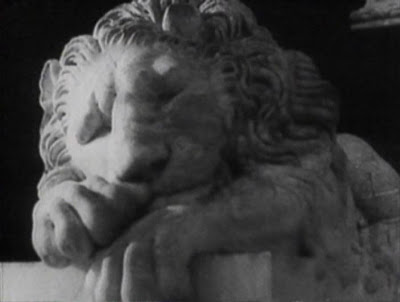
One more note, since I essentially bashed the most famous segment of the movie, that I'd like to include. My favorite example of montage theory in Battleship Potemkin is simple and effective. It is a series of three lion statues that gain meaning only through their placement next to each other.
It's just perfect. It's small. It takes about ten seconds of the film and it had a larger impact on me than the baby carriage rolling down the steps.
A final note that warrants comment. Part X in my continuing series on hilarious facial hair in old movies:

Final Score: 8/10

Wednesday, November 19, 2008

26. The Phantom Of The Opera - 1925

Director: Some nobody which is why I'll probably stop doing this section from now on unless I think it's especially relevant. Look it up yourself if my review doesn't mention it.

Synopsis: A phantom of the Parisian opera house forces the opera house to use Christine as their star because he loves her. The phantom lures Christine to his lair and professes his love. She removes his mask revealing his ugly countenance. She says she will be his slave forever but goes back on her promise. The phantom kidnaps her and Christine's boyfriend follows. Everyone in Paris also follows because they all find out where the phantom's lair is the exact same day. They are not particularly kind to the phantom. Also, there is some color footage.

Review: The version I watched was the 1929 version I believe.

In the early days of cinema, multiple versions of movies were made for a few reasons. Movies would be made for theaters (un)able to play sound films, later censorship or for foreign release (I find the two versions of The Testament Of Dr. Mabuse to be the most interesting as sound was so expensive that filming a movie twice was cheaper than redubbing a film for foreign markets!).
The most common version--read: the only one I have had the chance to see--of The Phantom Of The Opera is the 1929 version. The film was re-edited, used some different takes, used less color footage and incorporated sound differently. So, I'm not sure where the problems with this film began.

It's not that this movie does anything wrong; it never does anything as well as it should have. The Phantom Of The Opera is a perfect example of a movie that is almost great. There are some interesting elements here that are never fully explored. The movie could have been a straight horror movie or about a tormented musical genius gone mad or about love/obsession or a mystery. It tries to be all four and doesn't do any of them all that well.

Had the movie focused on one or two elements, it could have been a much better movie. It could done everything with a much longer running time--we call that the Dr. Mabuse, der spieler ratio--but it didn't. As it stands, most of the elements feel truncated. Since the movie supposedly follows the source novel closely, it's possible that this problem originated here.

That's not to say there isn't some great stuff here. This was popular enough to essentially spawn Universal's classic horror movies of the 1930s. That alone makes this meritorious. It is a perfect template for those movies in that the plot basically follows this formula:

Monster loves woman. Woman is horrified by monster and engaged to another. Woman's fiancée is not having it. Townspeople are also not having it. Monster is killed by torch and pitchfork wielding mob.
The memorable differentiation between these monster movies is the monster itself. Like the rest of the monster movies since The Phantom Of The Opera, the monster is one of the only things worth the viewers' time. The rest of the movie is waiting for the monster.

The monster is something to behold and not only because he is the only character written to have more than one dimension. Lon Chaney's make up is amazing. Apparently, smelling salts were kept on hand in case people fainted during the reveal of his skull-like face as shown above (compare the 1929 and 1925 unmasking shots here; the original is better). It is more impressive than the skull mask he wears to the masked ball later seen below. While the skull mask is creepy, it doesn't allow for any emotional acting like Chaney's make up does.

As you may have noticed from above still, this is the first color film--in part--on the list. It is not the first color film in whole or in part as films with color existed through various processes since probably the late 1890s. For example, A Trip To The Moon from 1902 supposedly exists in a hand colored version. The Phantom Of The Opera used Technicolor Process 2 (read how it works better than I can explain it here).

A final note and only because it is the best scene in the movie and I love it:

The Phantom, surrounded by the local townspeople, reaches into his cloak. He removes his hand clutching something that causes the mob to recoil. He opens his hand to reveal...nothing. The mob descends on him (an alternative ending featured Christine giving the Phantom her ring before leaving with her fiancée causing the Phantom to die of a broken heart).

Final score: 6/10

Friday, October 31, 2008

25. Seven Chances - 1925

There is a really tall woman just above Buster's head to the right.Director: Buster Keaton

Synopsis: To inherit seven million dollars, Buster Keaton must be married by 7:00pm on his 27th birthday which just so happens to be--gulp--TODAY!

Review: I must confess that I have actually seen The Bachelor starring Chris O'Donnell. I don't have a reason. It wasn't at the behest of a girlfriend. It wasn't the Ludovico technique. I sat down for no apparent reason and watched The Bachelor...probably on TBS.

"...because it was there" — Sir Edmund Hillary

Anyway, I was completely unaware until about a day before watching Seven Chances that The Bachelor was a remake of this movie (Seven Chances is itself an adaptation of a play). I don't remember how closely The Bachelor followed Seven Chances as the only memorable portion was Chris O'Donnell being chased by a mob of women in bridal gowns.

It is unfortunate that the only really memorable thing about Seven Chances is also the chase. The first half of this movie as Buster Keaton struggles to find a bride is acceptable but it's nothing particularly special after seeing some other Keaton work. It never took off as much as it probably could have. It seemed maybe too easy I suppose.

One bit that worked well was a reveal, after Buster makes his approach, that a woman has a child. After confirming the child is hers, Buster inquires whether or not she plans to take care of it. It was the biggest laugh for me until the chase scene.

The chase scene is the main reason to watch this. Buster Keaton gets to a church where his friend has assured him that a bride will be waiting and hundreds of women are ready to marry into seven million dollars. Not being keen on this idea, Buster runs through a series of increasingly dangerous and ridiculous gimmicks as Buster Keaton is known to do.

My personal favorite is this turtle holding onto his necktie:
Like much of the chase, there's very little reason or context for this. I like to imagine the writing process for movies like this because I wonder how something like this comes about. "Buster should jump in a river for three seconds just so he can come out with a turtle hanging from him."
So, old movies are pretty racist. (nice transition)

Buster becomes pretty desparate for a wife at a certain point in the film and asks almost every woman he comes across including drag queen Julian Eltinge. Buster doesn't bother asking a Jewish woman or a black woman as soon as he discovers their ethnicity. I guess that was probably funny in 1925. The only prominent black character is in black face as well.

Also of note is Christina Ricci's cameo:
Watch out Speed!  The mammoth car is right behind you!I liked this movie overall but it never felt like it was as funny as a Buster Keaton film should be (Keaton didn't even want the only surviving copy restored. I enjoyed Neighbors included on the DVD more than Seven Chances.

7/10

Friday, October 24, 2008

24. Der Letzte Mann (The Last Laugh) - 1924

Director: F. W. Murnau

Synopsis: A hotel porter is demoted to washroom attendant because he is old. His job, and uniform, brought him respect in his poor neighborhood. He hides his demotion from his family and friends by stealing his uniform. Upon being discovered, he loses all prestige and becomes miserable. Then the ending. The horrible horrible ending.

Review: It has been my dream to be involved in writing or directing a romantic comedy. A recently divorced woman bumps into a man just this side of nebbish to still appear desirable. They do not hit it off. The divorcée's friend recommends the "perfect guy" who turns out to be the man she met previously. Through a series of crazy coincidences, the two keep running into each other and slowly bond over some ridiculous shared trait (loves dogs, ham radio, whatever). Everything goes beat for beat like every romantic comedy in history until the final five minutes. The man, after their first night together, leaves the house. Shortly thereafter, the director to a local asylum for the criminally insane knocks on her door to inform her that her new lover is an escaped murderer. The boyfriend comes in, sees this and murders the both of them in a scene just gorenographic enough for Murder-Set-Pieces or the eventual movie of Blood Meridian. Credits roll.

What does this have to do with Der Letzte Mann?

Der Letzte Mann's ending is as surprisingly antithetic as my torture porn/romantic comedy and completely ruins everything the previous 95% of the movie. I knew going into this that the ending was supposedly tacked on by the studio and undermines what Murnau was doing. I imagined something pretty ridiculous and Der Letzte Mann went beyond my imagination. Never will there be an ending so bad, so tacked on, as this and I have seen A. I. If you remember The Simpsons episode with the alternative ending to Casablanca where Ilse parachutes from the plane killing Hitler and marries Rick with Sam playing piano outside the church, this is the kind of tacked on happy ending Der Letzte Mann has (see The Simpsons take on Casablanca here starting at 12:47). It overshadows the preceding 80 minutes and ruins the entire experience. I am genuinely angry at having sat through that ending.

I know movies are ultimately a product. Studios want to protect their investment and make money. It's a film industry. That doesn't mean films can't be altered for the good by a studio. I suspect the 155 minute version of Tati's Play Time drags even more than the current version. Maybe the excised footage from The Wizard Of Oz slowed down the film. I don't know but I know which version of Brazil or Army Of Darkness I prefer. I know that no one is asking to see the theatrical release of Touch Of Evil or the 141 minute version of Seven Samurai. Der Letzte Mann is the best example of why studios shouldn't meddle in movies. Of all the footage lost forever, why couldn't the last few minutes of this join it?

The ending is so horrifically bad, this screen precedes it:
Enough about the ending because it really shouldn't be here at all.

When Norma Desmond said in Sunset Blvd. that silent movies didn't need words because they had faces, this is the kind of movie she was talking about. This movie has only one intertitle before the introduction to the, ugh, end. The entire movie really is told by the faces of the characters. The doorman is in virtually every scene and without words he makes every scene watchable (partly because of his great facial hair).

With no dialogue or intertitles to tell the story, the movie relies even more than the average silent film on overacting. After losing his job, the porter is so overcome with shame and emotion that he moves about like a character from a Rankin/Bass Christmas special. It's unnerving to see the almost stilted movement.

More unnerving is the porter's phyical transformation. This still shows the porter at his absolute best in the film: This still is him at his worst:He has gone from smiling which a woman on each arm to a jobless thief who apparently has chosen the path with the least amount of grooming. Even his previously immaculate uniform has started to fall apart.

That is, essentially, the movie. It's watching a man lose everything for no real reason. It is not a uniform and job to him. It is his dignity--his means of respect from his peers--being taken from him. All because he is aging he loses everything.

So, it's not quite a feel good movie. It's a feel bad movie but the kind that is completely watchable and engrossing. If you want to feel bad, this is the movie to watch. If you want to feel even worse in a totally different way, watch the ending.

A final note because it must be mention. This has probably the most influential camera work in film history and the modern audience probably won't notice. F. W. Murnau called in "unchained camera technique." The modern terminology is "movement." There is no existing film released before Der Letzte Mann with a moving camera. It is believed that Der Januskopf may have had one scene with a moving camera, but it can not be confirmed as it is lost forever.
All camera movement--as this entire list from a few movies from now should contain save maybe some Ozu (heh)--can be tied back to this movie.

Score: 9/10 Please please please stop the movie before the tacked on ending.

Friday, October 3, 2008

23. Sherlock, Jr. - 1924

All the cars, minus that one in the foreground are moving.  Seriously.Director: Roscoe "Fatty" Arbuckle, Buster Keaton

Synopsis:They don't write 'em like that anymoreBuster Keaton is wrongfully accused of stealing a watch. He falls asleep and it all comes together nicely in the end...nicely for Buster Keaton not the guy that actually stole the watch.

Review: Film has the ability to be the most oneiric medium if only because it can assault the senses easier than any other medium. Adding that film typically assaults two senses--three or more if Odorama or Percepto is involved--which is one up on most other media, it is more immersive by nature. Seeing a film feature a dream literally become a movie is interesting at least.

The best part of Sherlock, Jr. aside from the "How did Buster Keaton not die while doing that?" motorcycle section is the movie within a dream within a movie. I really couldn't decide what part struck me hardest: Keaton walking from the stage through the screen or Keaton's reacting to the ever changing background. Barring this being removed from Youtube, see it here. It's obvious that jump cuts were used extensively to place Buster in the rapidly changing background but it's staged so well that it's hard to spot.

Beyond blurring the distinction of film and dreams, reality is added into this. It's a blurring of Keaton's dream, the film Keaton is watching which is also called Sherlock, Jr., and how each of these things affects Keaton's reality within the film.

Keaton is dreaming about himself Sherlock, Jr. while the film's audience watches Sherlock, Jr. while we are watching Keaton as Sherlock, Jr. I am having flashbacks of trying to explain Wes Craven's New Nightmare to someone right now and my mind is being blown by the comparison. Anyway, Keaton is dreaming of the case being solved and he awakes to the case being solved. Even Last Action Hero didn't get this deep. My mind is again blown by this apt comparison.

Enough of all this high brow dissection of Sherlock, Jr. This movie is funny. Isn't that what Buster Keaton is all about? I know The General is general-ly considered Keaton's masterpiece but I have my doubts after seeing this; I haven't seen it recently enough for a quality comparison. I guess I will know in a couple weeks when I see The General again.

This benefits so much more from being shorter--44 minutes--than Our Hospitality. There is no room for boredom. Even if a joke doesn't work which is rare in this one, another one immediately follows it. This suffers a bit from the same "flaw" of Our Hospitality that audiences have seen physical comedy evolve for 80+ years. Portions of this don't work quite as well as they did in 1924. Buster does his physical work as well as anyone today does and does it better for the most part.

For example, the still above is from Buster Keaton riding on the handle bars of a motorcycle with no driver through moving traffic. It's amazing because there about a dozen scenes that are all ridiculously dangerous and this isn't the scene where he BROKE HIS NECK. I could go on about the amazing physical work Keaton employs here and elsewhere in the film but it must be seen to be believed.

I suppose the plot is kind of lacking on this but it doesn't really matter. Sherlock, Jr. was made to have Buster Keaton do his thing which he does. Even the subdued by comparison to his death defying work is great. He can show pain and dejectedness in his face gaining the right amount of sympathy and laughs.

Some side notes that don't really fit in anywhere else and I'm too lazy to flow into rest of this:

Something I had never seen in a film before or since is the actors--not characters--named in the intertitles. I had technically seen this before but must shamefully admit to wondering why the Canfield family in Our Hospitality had a daughter named Natalie Talmadge. Ummm...I am a stupid.

Of particular note is the horrific score on the Kino print. I think it was by Club Foot orchestra or something. I can not fathom someone thinking this is remotely appropriate. There are sections that border on jazz fusion. There is surf rock. There is an honest to God James Bond reference. I'm not sure which is worse, the Kino soundtrack or the Youtube clips that feature J. Geils Band and Air.

Large sections of this are on Youtube. I didn't see the part where Buster gives away dollar after dollar to movie patrons or him literally following a suspect closely. The other truly brilliant moments are there though. Find the whole thing as this is totally worth it.

Score: 9/10

22. Greed - 1924

Director: Eric Von Stroheim

Netflix doesn't have this. I found a copy online. I'll watch it at some point, but I hate staring at my crappy monitor for hours to watch a movie. I'll get around to this (soon?).

EDIT: Whoops. I had some serious computer issues and lost this file. The site from whence it came is no longer operational...again. I'll watch this some time

Wednesday, September 17, 2008

News of sorts

I was in Barnes & Nobles today and discovered, as I suspected, that different editions of this book have different films listed. I happened to notice this because the version I glanced at in the store had several movies from 2007 while mine stops with The Aviator and Million Dollar Baby (why for both choices?). I have seen all of the movie differences I noticed at the end; it isn't a big deal (why Atonement which kind of sucked after the first 30-45 minutes?).

Does anyone that happens upon this blog know where I can find a list of the movies added and removed for each edition? It appears that the editor just takes out an old movie and replaces it with some recent big name movie (Atonement? Really?). I'd like to add in the movies from different editions some time in the future.

Unfortunately, all editions have both Moulin Rouge! and Fahrenheit 9/11. I guess I can't use that as an excuse to skip them.

Saturday, September 13, 2008

21. Stachka (Strike) - 1924

Director: Sergei Eisenstein

Synopsis: Workers of a factory strike after being treated poorly and a worker suicide. The factory directors are none too happy about this. Neither side will give in and the results are violent.

Review: "The strength of the working class is organization. Without organization of the masses, the proleteriat is nothing. Organized, it is everything. Being organized means unity of action, the unity of practical activity." Lenin, 1907

That quote opens Strike. This quote, intercut with eyes staring angrily at the viewer (pictured above), closes Strike:

"REMEMBER, PROLETARIANS!"

So...Eisenstein wasn't taking a subtle approach with Strike but he once said, "I don't believe in kino-eye, I believe in kino-fist" assuring that a subtle approach wasn't to be expected...ever. Propaganda films, as this film undoubtedly is, rarely go work at a level below beating the audience over the head with its message.

While watching--but before researching--this movie, I was struck most by the juxtaposition that Eisenstein (over)uses. A large percentage of the shots reference the preceding or succeeding shot in a way to alter both had they been shown separately.

For example, the opening of the movie has an intertitle claiming the "all is call at the factory." The next shot is dozens of men and women coming in and out of a hallway filled with doors. Neither means that much when seen separately; the factory looks abnormally busy, but not enough to warrant much notice. When seen together, it comes across as a much busier--almost humorously so--factory because we are told the factory is calm.

This juxtaposition is called Soviet montage theory and Eisenstein considered it "the nerve of cinema." Again, Eisenstein wasn't one for subtlety and montage is overused. One could say that Strike is propaganda for the usefulness of montage theory. At the least, this is a primer for how to use it in film and it has been used as such--compare the finale of Strike and Apocalypse Now or most of Blood Of The Beasts or a section of Walkabout or...

I want to comment on one particular non-montage shot that works using juxtaposition but doesn't fit in the film. It is probably my favorite shot in the movie though. This pair of legs:
walk in reverse motion to reveal this pair of smokestacks reflected in a puddle: I think the shot works only because of the similar visual composition. It make little sense within the scope of the movie. There is no reason to start with the legs upside down without context except to mirror the smoke stacks. There is no reason to have everything happen in reverse except to make this shot have smooth water in the puddle. Within this movie, it feels like complete wankery.
If this were the only film Eisenstein had done, his montage theory would be enough to make this, and him, important.

Score: 7/10

Tuesday, September 9, 2008

20. The Thief Of Bagdad - 1924

Arabian movie with flying carpet?  If you say so!
Director: Raoul Walsh

Synopsis: A thief, while stealing items from a palace, falls in love with the princess. She is choosing a husband the very next day. The thief tricks his way into the group of potential hubands until his identity is uncovered. The princess had all ready decided the thief was the one for her (through fortune telling) comes up with a quest for the remaining princes to bring the rarest treasure within the next seven moons. The thief naturally chooses to go for the quest as well.

The Mongol suitor has decided to take over Bagdad by winning the quest or force. When the remaining suitors return, the princess and her father haven't yet decided on the winner. The Mongol chooses to take over with the city. The thief returns with his treasure which is basically some sort of box with wishing powder or something. He uses it to save the day and he wins the girl.

Review: I spent a good deal of time while watching The Thief Of Bagdad mulling over if this qualified as derogatory toward the people and cultures of the Arabian Peninsula. The movie is not actively negative, but it felt like P. T. Barnum humbugging an oddity supposedly found in the deepest deserts of Arabia. Imagine an Iraqi movie about the Old West without a single white actor and everyone is portrayed like Johnny Appleseed meets Pecos Bill. That's how I imagine an Baghdad citizen reacting when they see this movie. So, take this for what it is.

What it is is pure entertainment. There is no message here. There are no ulterior motives. Drawing a line from this to the summer blockbuster phenomenon is not difficult because of this. The template for every contender for biggest hit of the summer--take everything you've seen before and make it bigger--is right here. Blaming Douglas Fairbanks for the sins of modern day Hollywood executives is unfair and rather mean.

Douglas Fairbanks, with whom I am unfamiliar other than uncredited "Man On Horse" from Intolerance, was the pre-Errol Flynn swashbuckling go to guy. He also wrote, produced and starred in this which I've learned is not as recent a convention in film as I thought. Imagine a film made to capitalize on what swashbuckling stars do best, then set it Bagdad. This is the movie playing in your head and it's all here.

For all the greatness that Douglas Fairbanks stuffed into this film--there are a lot of it--the best thing here is the set design. Very few movies are made by their sets (see pictures below - the sets really are that big and took six and one half acres to build). This may be the only one or it is the only one I can think of. The sets are a spectacle by themselves and the film would have lost its power if production designer William Cameron Menzies were reigned in some.
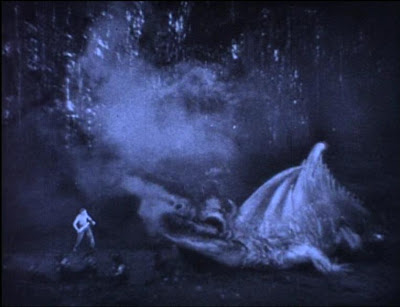
The sets are not the only thing of note because there are some special effects that work to varying degrees (see picture below). Overall, this movie accomplishes exactly what it set out to do by keeping me entertained except I do think it should have been a bit shorter. There really isn't more to say than that.Shadow Of The Colossus
Final note: Why do the intertitles lapse into Jacobian English occasionally? Methinks "thou" wasn't used much in ancient Iraq.

Score: 8/10

Saturday, September 6, 2008

19. La Roue (The Wheel) - 1923

Netflix does not have this and I'm not paying $35.99 for it. Place holder until I can find this.

Thursday, September 4, 2008

18. Our Hospitality - 1923

Dude is straight up hanging from a log over a waterfall.
Director: John G. Blystone, Buster Keaton

Synopsis: Willie McKay returns home for the first time in 20 years to claim his father's estate. He falls for a girl on the trip each unaware they are opposing members of a familial blood feud. McKay must avoid being murdered while attempting to win the girl. Doesn't that sound like a comedy?

Review: Explaining why physical humor works--facial gags in particular--is virtually impossible. This is a new idea that has never once been mentioned in the reviews of Keaton; do try to keep pace. Somewhere between "Buster Keaton makes a face that is funny" and actually seeing Buster Keaton's reaction the humor is lost. This film is a perfect example of having to be there to get it.

Having to be there to get it comes in at another level. I can't help but think that I'm missing something by not being around in 1923 or experiencing first hand Southern hospitality. Seeing the evolution of physical humor and decline of hospitality in general for 80+ years works against a modern viewer. I see the jokes. I get the jokes. I don't laugh at many of them. The best way to describe it is seeing I Love Lucy after seeing every comedy since steal from I Love Lucy; the impact isn't the same as it once was.

Perfect example: Natalie Talmadge comes on screen. Before being introduced a few seconds later by intertitle, I know that Buster Keaton is going to fall in love with her and she is going to be a Canfield leading to comedy. This is so standard that there isn't even a name for the it. It's a bit backwards knocking a movie for doing something so right that even those unaware of Keaton are aping his work. I won't claim that Keaton originated the unlikely romance leading to comedy as that probably belongs to the first teenager but this is the first instance to my knowledge on film.

Anyway...Our Hospitality does have some great things working for it. Once the movie gets going and it becomes Buster's show instead of an overly long trainsequence, the quality raises immediately. Keaton is probably the master of oblivious comedy where everything happens around the protagonist while he remains clueless to his surroundings which is pretty heavily done for a while here. It's a subtle difference between that and Tati's Monsieur Hulot for example who was overcome by his circumstances.

Where Buster really shines is when he becomes suddenly aware of his situation at the Canfield's. He's able to use his face more which is previously pretty unexpressive. I think the most under appreciated scene in Our Hospitality, because the waterfall sequence truly deserves the most praise, is Keaton attempting to prolong his first evening with the Canfields. Keaton realizes he has to stay to avoid certain death and starts performing some tricks with a dog. After two tricks, he has nothing and performs them again with an earnest begging for approval across his face. As stated earlier, it's impossible to describe physical humor and facial gags.

I guess I should talk about the waterfall sequence. It's pretty amazing and a shame that truly dangerous gags don't make it into movies anymore. Of course, Keaton lost control of a guide rope and hurtles down the river lucky to be alive. Studio wariness isn't baseless but knowing that Jackie Chan is the only direct descendent of Buster Keaton is rather a drag.

Our Hospitality works but mostly in the latter half of the film. It's difficult to rate the film so low but there are too many low sections to rank the film highly.

Score 6/10

Tuesday, September 2, 2008

17. Foolish Wives - 1922

Director: Erich von Stroheim

Synopsis: I don't know.

Review: Netflix skipped this. They sent this before I went on my four and a half month hiatus. I sent it back when I put my account on hold. This is a place holder until I actually do see this. Though I have no reason to feel this way as I have never seen a film directed by von Stroheim, I am not looking forward to this at all.

Thursday, May 8, 2008

Too busy for movies

GTA IV is currently out and METAL GEAR SOLID 4: GUNS OF THE PATRIOTS comes out next month. I got no time for movies right now. I'll start this up again later.

Monday, April 14, 2008

16. Häxan - 1922

Director: Benjamin Christensen

Synopsis: Pseudo-documentary about witchcraft through the ages.

Review: This starts out with a synopsis of what people in the middle ages thought of the devil and witchcraft. There's a lot of "Here is a picture. Note the following things about the picture." It's pretty boring honestly.

The rest of the movie is a fictional story about a witch. Essentially it follows a few witches from them making potions to their trial. It takes a somewhat sympathetic view on how women were baselessly tortured after being accused of witchcraft. This is where the movie takes off because it's where the shock value kicks in (the still above is a woman literally giving birth to a demon spawned by Satan).

I think this movie really had a lot of great staging and special effects (the coins flying away in reverse was probably impressive at the time). I think it took an interesting look at mental illness even if it was not entirely correct. It also tried to put us in the shoes of what it might feel like to be accused of witchcraft. All that stuff is nice, but I really loved the shock value and portrayals of the devil. So, here are my top five listed from least favorite to favorite:
05. The devil making out with a witch
04. Literally beating a nun over the head with a club03. A line of women literally kissing his butt

02. Satan playing some sort of bagpipe/saxophone hybrid.

I could not guess what this is supposed to mean01. The devil churning butter.

Score: 7/10